

Cloud Computing vs. On-Premises: Why Proxmox is Winning in 2026
March 3, 2026
The Micro-Burst Epidemic: API Security Best Practices for 2026
March 12, 2026
Choosing the right storage foundation is the single most critical decision you will make when architecting a Proxmox Virtual Environment (VE).
It is the decision that dictates your performance limits, your ability to survive hardware failures, and how painfully (or easily) you can scale your cluster next year.
In 2026, the landscape has changed. Spinning rust (HDDs) is relegated to archival duties, NVMe is the enterprise standard, and 25GbE networking is affordable even for smaller deployments. This modern hardware landscape reshapes the classic debate between the two heavyweight contenders of the Proxmox world: ZFS and Ceph.
Neither is universally “better.” The correct choice depends entirely on your specific infrastructure goals, your budget, and whether you value raw speed over absolute resilience. Let’s break down the realities of Proxmox storage in 2026 to help you make the right call.
To choose correctly, you must understand what these systems are fundamentally designed to do. They solve the storage problem in completely different ways.
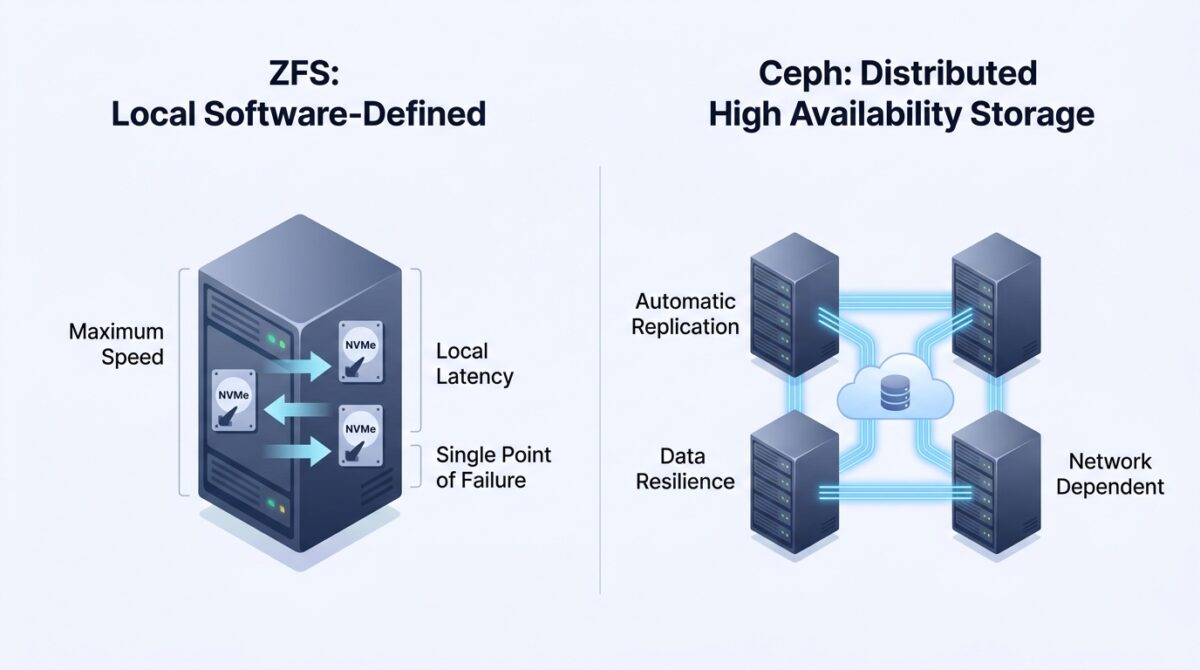
ZFS is not just a filesystem; it is a combined logical volume manager and hardware controller. It is renowned for its data integrity features, incredible compression, and powerful snapshot capabilities.
When you use ZFS with Proxmox, you are almost always using it as local storage. The physical NVMe drives live inside the compute node, and ZFS manages them directly.
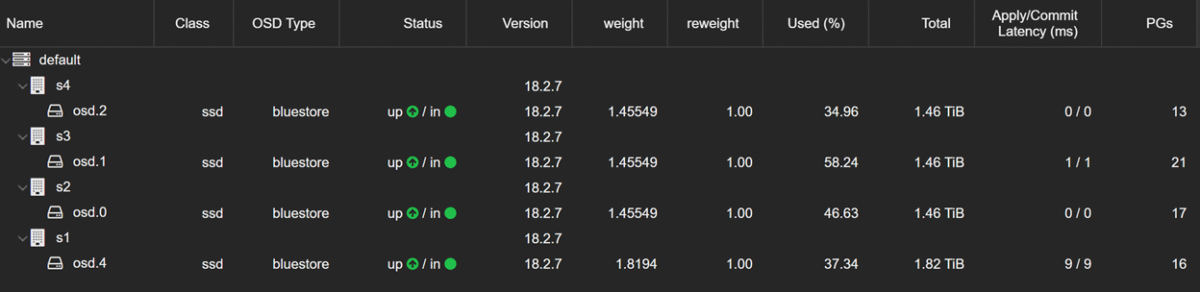
Why Ceph Wins on Resilience: Ceph is built for High Availability (HA). Because data is replicated across the network, if an entire Proxmox node catches fire, your VMs don’t care. Proxmox detects the failure and instantly reboots those VMs on a healthy node. The data is already there, safe in the Ceph pool. This self-healing architecture is the gold standard for enterprise uptime.
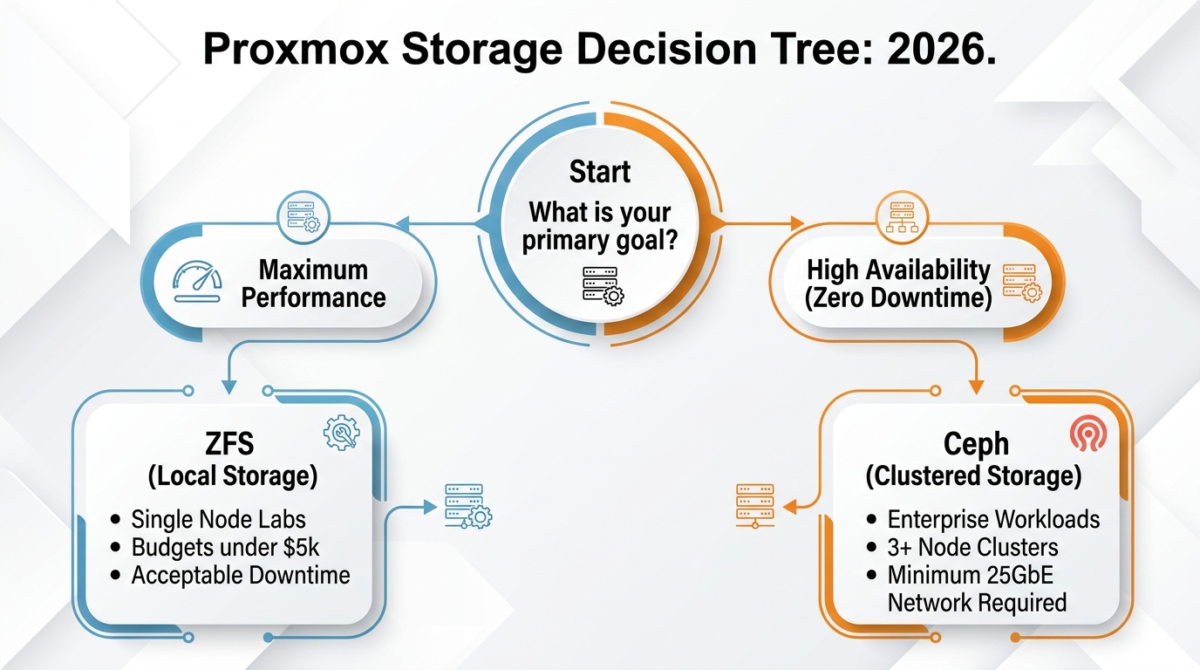
The Ceph Constraint: Ceph’s limitation is hardware dependency. In 2026, networking is the bottleneck. Even with modern NVMe drives, your storage speed is limited by how fast data can travel across the network for replication. To make Ceph perform well, a dedicated, high-speed mesh network (minimum dual 25GbE, ideally 100GbE) is a non-negotiable requirement.
The performance gap between these two systems has narrowed slightly in 2026 thanks to faster networking and more efficient Ceph code, but the architectural core remains. The “best” choice is defined by your use case.
There is no singular, perfect answer in the storage debate. In 2026, the most sophisticated Proxmox architectures often embrace a hybrid approach. Many IT managers use the distributed resilience of a Ceph cluster for the vast majority of their standard VMs, while reserving one or two nodes with blazing-fast local ZFS pools specifically for their most IOPS-intensive database workloads.
The shift toward high-performance, open-source storage foundations like Ceph and ZFS is exactly why Proxmox is winning against restrictive, expensive commercial hypervisors. You are no longer locked into proprietary SAN hardware; you are empowered to choose the precise level of speed and resilience your organization requires.
Take stock of your networking capabilities, define your acceptable downtime, and build the cluster that serves your 2026 workloads.
Architecting the perfect storage foundation for your Proxmox environment isn’t a one-size-fits-all process. Whether you are still weighing ZFS against Ceph for your specific enterprise workloads, or you need hands-on help designing and deploying a highly available cluster that fits your budget, I am here to help. Head over to my Contact me page, drop the details of your server setup, and let’s build an infrastructure that works for you!