

Dutch Government Warns of Signal and WhatsApp Account Hijacking Attacks
March 19, 2026
Picking the wrong VPN can quietly ruin your setup. Maybe your connection is slow. Maybe it drops without warning. Or maybe you’ve spent hours configuring something that was never meant for your use case.
The good news? You don’t need to guess anymore.
WireGuard, Tailscale, and ZeroTier are three of the most talked-about VPN tools right now and they each serve a different purpose. Whether you’re running a home lab, managing a small business network, or working on a personal side project, this guide will help you pick the right one.
Let’s cut straight to it.
Most people assume all VPNs do the same job. They don’t. Think of it like this: a sledgehammer, a screwdriver, and a Swiss Army knife are all tools — but you wouldn’t use them interchangeably. VPNs work the same way.
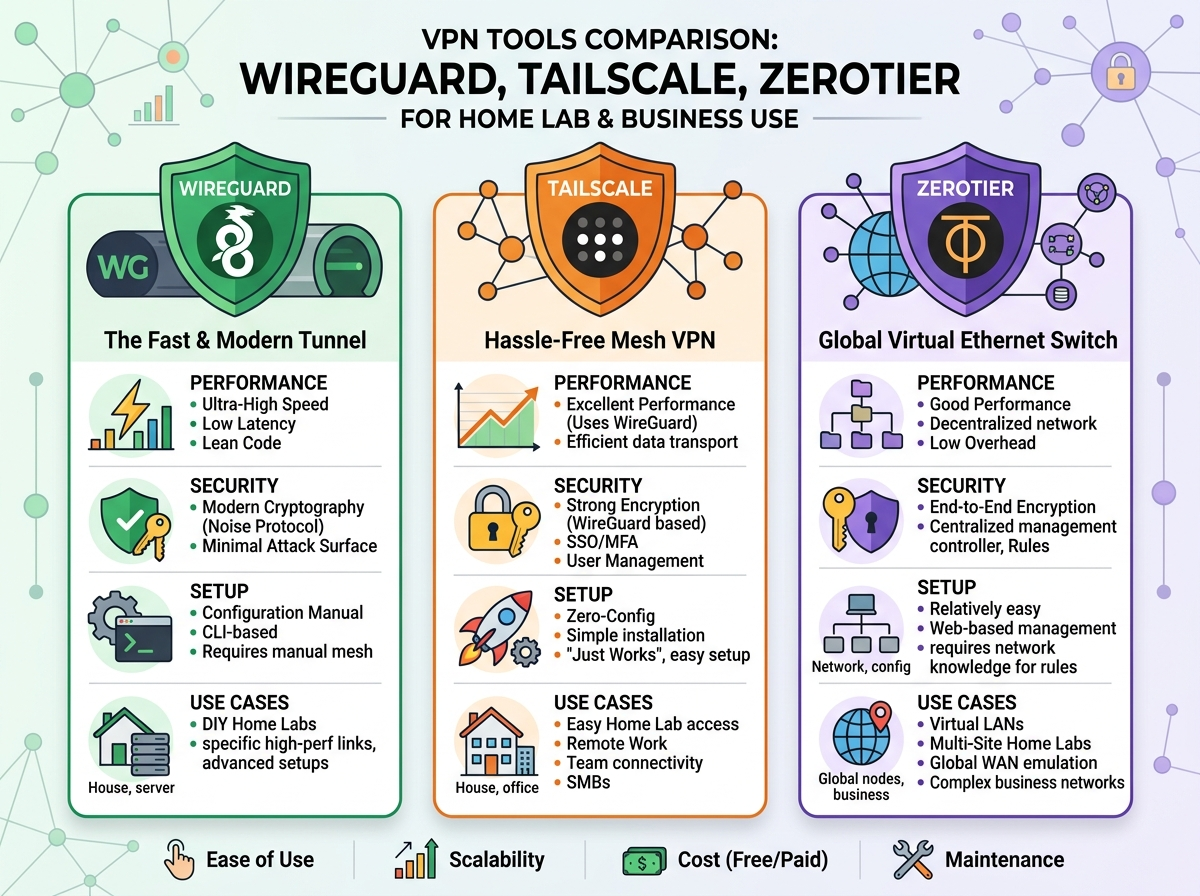
WireGuard is a modern, open-source VPN protocol built directly into the Linux kernel. It’s fast, lean, and brutally efficient. Unlike older protocols such as OpenVPN or IPSec, WireGuard’s codebase is tiny roughly 4,000 lines compared to OpenVPN’s 100,000+. That makes it easier to audit, maintain, and trust.
What it’s great for:
The catch: WireGuard is a protocol, not a fully managed solution. You’ll need to handle key management, peer configuration, and firewall rules yourself. It rewards those with networking knowledge.
Tailscale is built on top of WireGuard, but it wraps the complexity in a clean, managed interface. Once installed, devices appear on a shared private network no port forwarding, no firewall headaches, no manual key exchange.
It uses your existing identity provider (Google, GitHub, Microsoft) for authentication, which means zero user management from day one.
What it’s great for:
The catch: The free tier supports up to 100 devices and 3 users. For larger teams or advanced features, you’ll need a paid plan. Also, your network does pass through Tailscale’s coordination server for key exchange though traffic itself is peer-to-peer.
ZeroTier takes a different approach entirely. Rather than acting as a traditional VPN tunnel, it creates a virtual Ethernet layer over the internet. Your devices behave as if they’re on the same local network — even when they’re physically thousands of miles apart.
What it’s great for:
The catch: ZeroTier introduces slightly more latency than WireGuard because of its peer discovery process. It’s also not ideal for high-throughput workloads where raw speed matters most.
Now comes the real question. Here’s a clear breakdown by use case so you don’t overthink it.
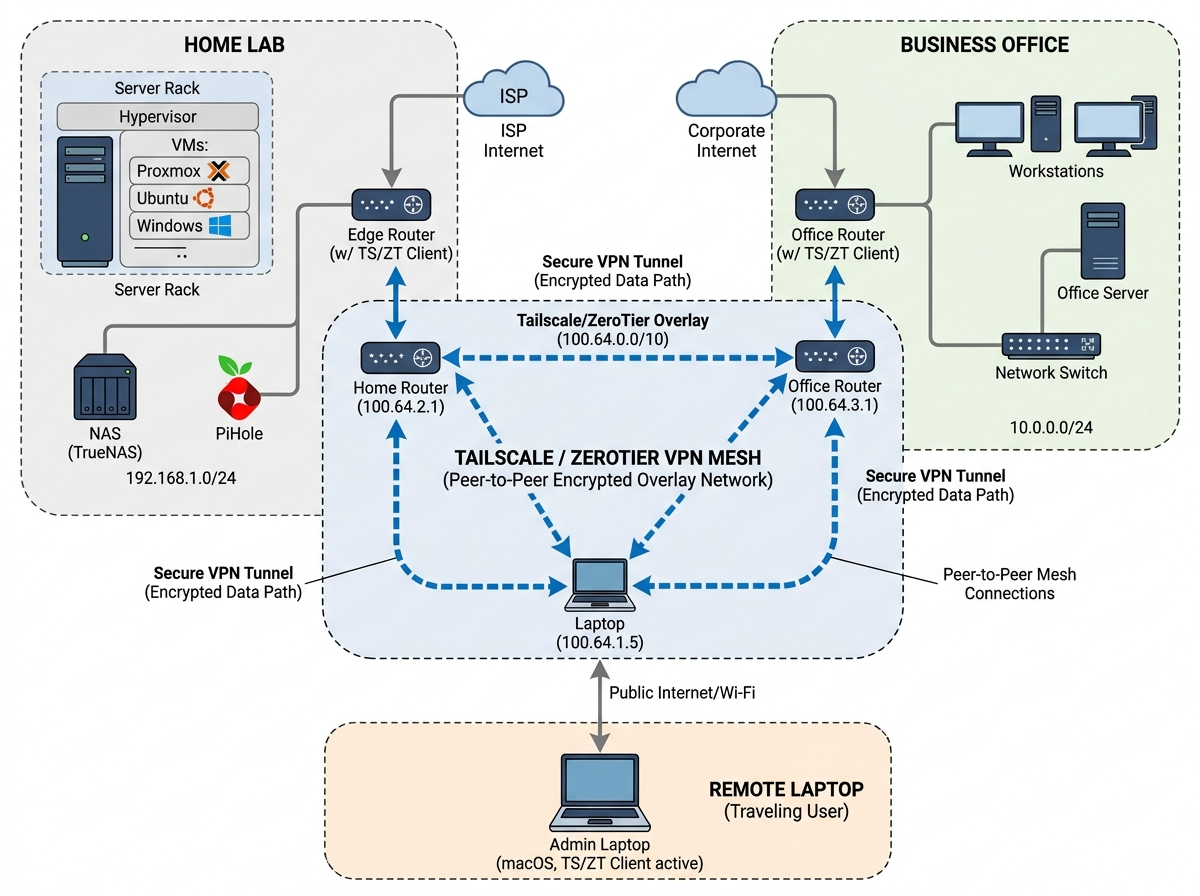
If you’re running a home lab Proxmox, TrueNAS, Raspberry Pi clusters, self-hosted apps Tailscale is almost always the right starting point. You can be up and running in under ten minutes. Your devices get stable, private IPs. SSH, HTTP, and everything else just works across your network without touching your router.
Once you’ve outgrown Tailscale’s simplicity or want full control, migrating to a bare WireGuard setup is a natural next step. It takes more time to configure, but nothing beats it for performance in a self-managed environment.
ZeroTier also works well for home labs particularly if you want to simulate a LAN across physical locations or share your lab with a friend remotely.
For small teams that need secure remote access without hiring a network engineer, Tailscale is a no-brainer. Its Teams and Business plans give you access controls, audit logs, and device management things that matter when you’re responsible for other people’s data.
WireGuard is a strong option if your business already has infrastructure expertise and wants to keep everything on-premises. Tools like Netbird or Headscale can give you a self-hosted coordination layer similar to Tailscale useful if you have strict data sovereignty requirements.
ZeroTier suits businesses with multiple physical sites that need seamless LAN-like connectivity. Think retail branches, small clinics, or remote offices sharing internal resources.
For personal use, both ZeroTier and Tailscale offer generous free tiers. If your project involves a handful of devices a VPS, a home server, a laptop either will do the job well.
ZeroTier’s free plan supports up to 25 devices. Tailscale’s free tier supports 100 devices. For most personal projects, neither limit will be an issue.
If you’re building something that requires ultra-low latency or custom routing, invest the time in WireGuard. It’ll pay off.
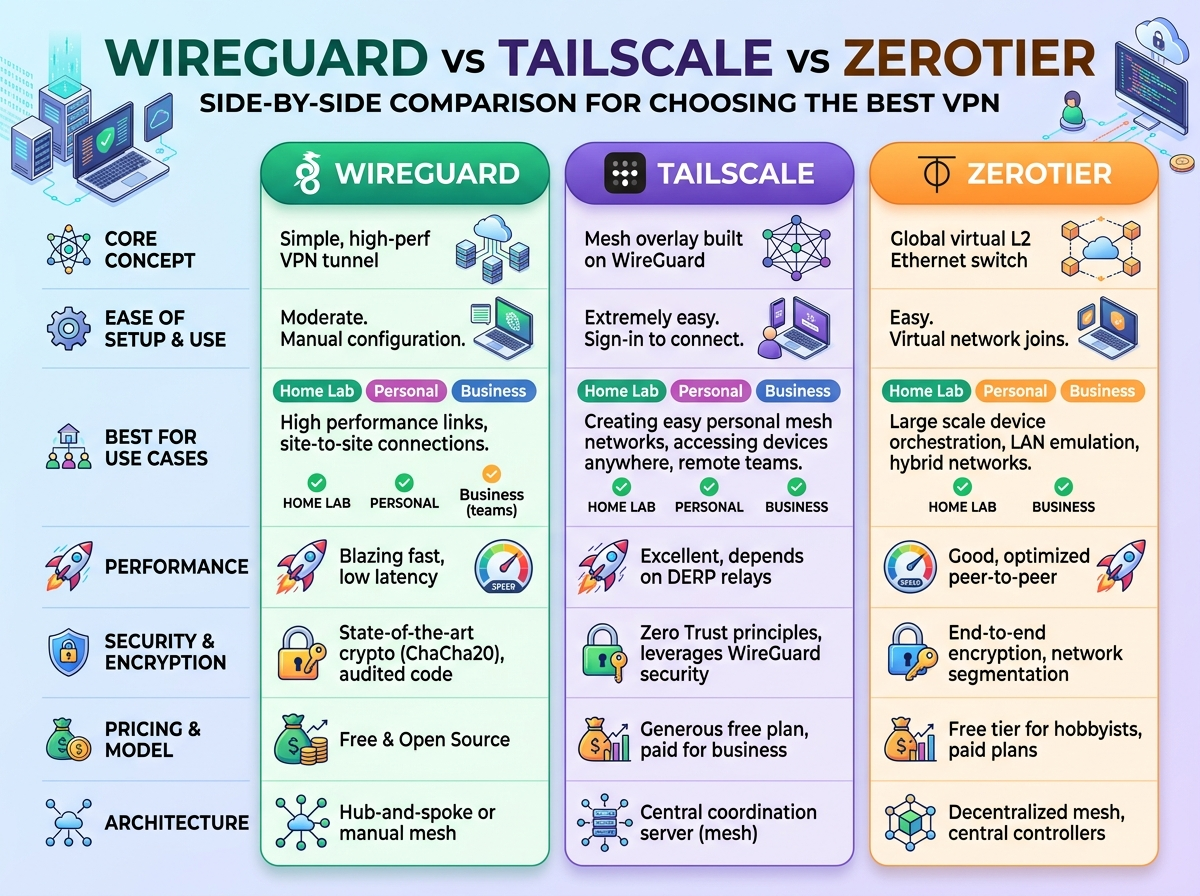
| ⚡ WireGuard | 🔒 Tailscale | 🌐 ZeroTier | |
|---|---|---|---|
| Setup Difficulty | High | Low | Medium |
| Speed | Fastest | Fast | Moderate |
| Best For | Advanced users | Teams & home labs | Multi-site & IoT |
| Free Tier | Open source | 100 devices, 3 users | 25 devices |
| Self-Hosted Option | Yes | Via Headscale | Yes |
| Managed Option | No | Yes | Yes |
There’s no single “best VPN” only the right one for your situation.
Start with Tailscale if you want something that just works without hours of configuration. Move to WireGuard when you want full control and maximum performance. Choose ZeroTier when you need distributed devices to behave like they’re on the same local network.
The biggest mistake you can make is picking a tool based on hype rather than your actual needs. Now you know the difference, use that.
Need help setting up WireGuard, Tailscale, or ZeroTier for your home lab or business? I offer hands-on network configuration and consulting services. Get in touch and let’s sort it out together.