

The Ultimate Visual Guide to Installing a VM in Microsoft Azure
March 1, 2026
Proxmox Ceph vs ZFS: Which Storage Should You Choose in 2026?
March 6, 2026
For the better part of a decade, the IT industry’s default answer to infrastructure was simply, “Move it to the cloud.” Public cloud platforms offered unparalleled convenience, rapid scaling, and the promise of ditching the physical server room forever.
But in 2026, the narrative is shifting.
As cloud bills swell and commercial hypervisor licensing models become increasingly restrictive, organizations are taking a hard look at their infrastructure. The result? A massive resurgence in on-premises deployments. But we are not going back to the fragile, single-server setups of the past. Today, open-source virtualization platforms are delivering enterprise-grade resilience, and Proxmox Virtual Environment (VE) is leading the charge.
Here is a look at why the pendulum is swinging back to on-premises, and why Proxmox is the hypervisor of choice for modern IT architecture.
There is no denying that the public cloud is incredible for dynamic, unpredictable workloads. If you need to spin up a web app that might go viral overnight, the cloud is where you want to be.
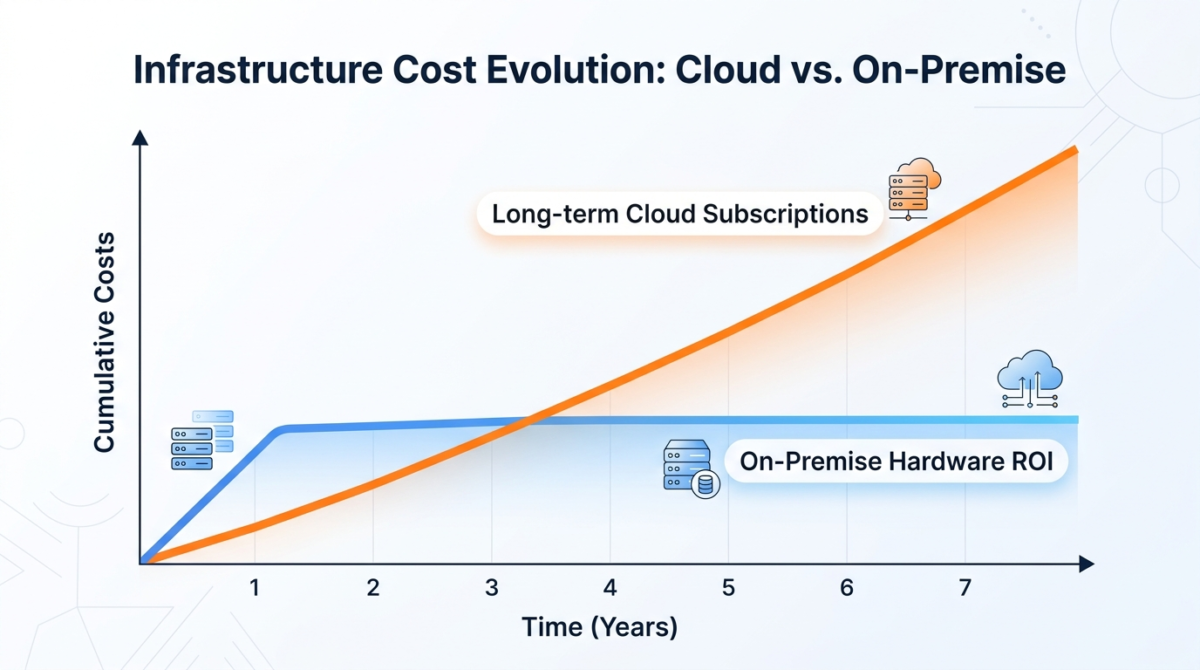
However, for predictable, steady-state workloads like internal active directory servers, database clusters, or line-of-business applications renting compute power month after month eventually eclipses the cost of owning the hardware. When you add in data egress fees and the premium charged for high-performance storage, the “cheap” cloud quickly becomes a primary budget drain.
This financial reality is pushing IT managers toward an intentional hybrid model: keeping public-facing, dynamic apps in the cloud, while bringing heavy, predictable workloads back on-premises.
When bringing workloads back in-house, you need a hypervisor that doesn’t just replace cloud costs with astronomical software licensing fees. This is exactly where Proxmox VE shines.
Built on Debian Linux, Proxmox utilizes KVM (Kernel-based Virtual Machine) for virtual machines and LXC for lightweight containers. It provides a clean, web-based GUI that rivals top-tier commercial competitors, right out of the box. More importantly, it doesn’t lock critical features behind expensive enterprise tiers. Features like live migration, automated backups, and advanced networking are native and accessible to everyone.
The biggest fear of moving away from the cloud is hardware failure. In Azure or AWS, if a physical server dies, your VM spins up elsewhere. To achieve that on-premises, you need High Availability (HA).
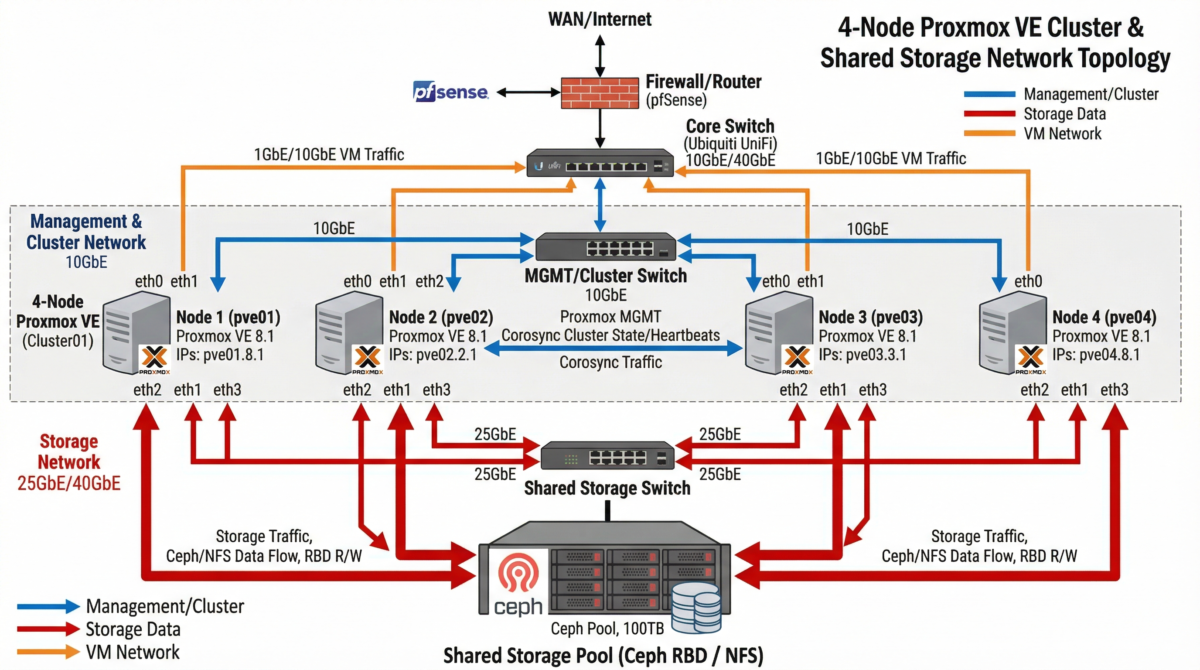
A highly resilient, production-ready environment can be achieved by architecting a 4-node Proxmox cluster. Why four? While a 3-node cluster establishes the necessary “quorum” to prevent split-brain scenarios (where nodes lose contact and try to control the same resources), a fourth node provides comfortable overhead.
| Feature | Public Cloud (Azure, AWS) | On-Premise (Proxmox VE + Ceph) |
|---|---|---|
| Upfront Cost | Very Low (Pay-as-you-go) | High (Purchasing servers, networking gear) |
| Long-Term Cost | High (Recurring monthly fees, data egress charges) | Low (No monthly compute fees, open-source software) |
| Control & Privacy | Shared responsibility model; data lives on someone else's hardware. | 100% absolute control over hardware, data, and security policies. |
| Scalability | Instant and virtually limitless. | Requires physical hardware purchases to expand capacity. |
| High Availability | Built-in via availability zones (often costs extra). | Achieved locally via clustering (e.g., a 4-node setup with distributed storage). |
| Maintenance | Hardware is managed by the cloud provider. | You are responsible for hardware replacements, networking, and power. |
In a robust 4-node setup, you can comfortably host upwards of 45+ heavy-duty Virtual Machines. If one physical server experiences a catastrophic hardware failure, the cluster seamlessly redistributes those VMs across the remaining three nodes with virtually zero downtime.
You can’t have High Availability without shared storage. Traditionally, this meant buying a massively expensive SAN (Storage Area Network). Proxmox changes the game by natively integrating Ceph, an open-source, software-defined storage solution.
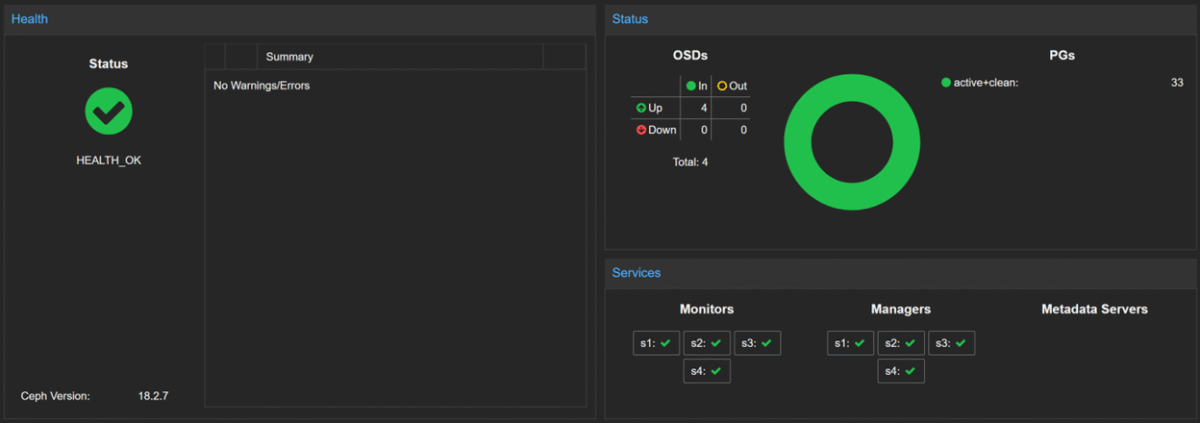
Ceph takes the internal hard drives of your 4 Proxmox nodes and pools them together over a high-speed network (10GbE or higher). It automatically replicates your VM data across the different physical servers. There is no single point of failure. If a drive dies, Ceph heals itself. If an entire node dies, your data is already safely stored on the others, allowing Proxmox to instantly reboot the affected VMs.
The debate in 2026 is not strictly “Cloud vs. On-Premise” it is about using the right tool for the job.
Public cloud remains essential, but blindly throwing every workload at it is no longer the default strategy. By leveraging the power of Proxmox VE and Ceph, IT professionals can build on-premise environments that rival cloud resilience, maintain complete control over their data, and drastically reduce long-term infrastructure costs.
The virtualization shift is here, and open source is winning.
The shift toward intentional on-premise infrastructure is accelerating. If you are tired of unpredictable cloud billing or restrictive hypervisor licensing, a highly available Proxmox and Ceph setup is a proven, enterprise-grade solution.
If you are planning your own migration or need advice on sizing a multi-node cluster for your specific workloads, I am here to help. Drop me a message directly on my Contact Me page, and let’s talk infrastructure